
Beyond PUE: Liquid Cooling and the
Hunt for Stranded Power
By eliminating compressor-based cooling overhead, operators can redirect previously allocated infrastructure power toward revenue-generating compute workloads. As operators adopt single-phase spray cooling, they'll reap sustainability benefits, while also unlocking stranded power and transforming it into additional computing capacity and revenue.
Tracking Effectiveness:
The Case for PCE
Traditionally, PUE and WUE are used to track liquid cooling effectiveness. However, as data center designs and needs evolve, so must the terminology. Power Compute Effectiveness (PCE) is an emerging performance metric for AI-era data centers. While PUE typically measures facility cooling efficiency, PCE is a ratio of power being allocated for compute compared to the overall power capacity of the data center. The higher the score, the more compute that is delivered without adding megawatts, infrastructure, or delay. PCE is powerful in that it is a ratio that helps measure the amount of power that generates revenue.
Think of it this way: If a data center is a delivery fleet, PUE measures how fuel-efficient the trucks are (the facility), but it doesn't tell you if the trucks are actually carrying any cargo. By comparison, PCE measures how many packages are actually delivered per gallon of fuel (the compute output). By sticking with traditional air cooling, operators are essentially burning 60 percent of their fuel just to keep the empty trucks running cool, rather than delivering the 'cargo' of AI processing.
Example of Direct-to-Chip Data Center with Chiller compared to Compressorless System
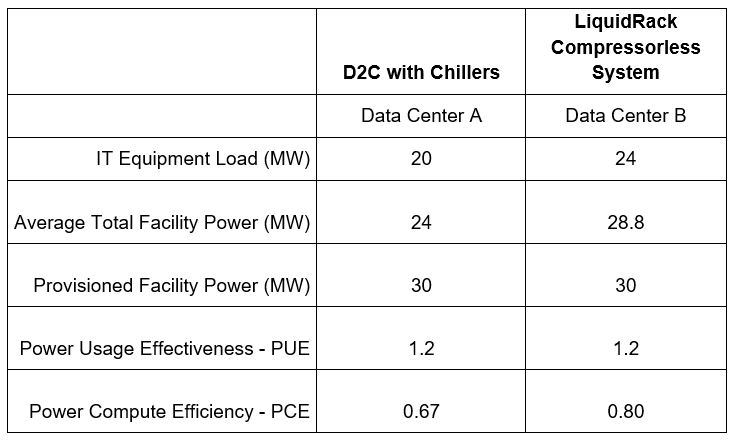
Table 1 - Data center power comparison between D2C with Chiller and Compressorless System
Click to enlarge
Operators can still use PUE as an effective performance metric, but PUE should be measured in combination with PCE. Together, they provide a complete view of both efficiency and output, enabling operators to maximize compute density, accelerate time to capacity, and minimize capital expansion.
As the AI data center revolution continues, liquid cooling has gone from a niche technology to the industry standard for hyperscale workloads, AI training clusters, and sustainable data center builds. These efficient and effective compute environments are only made possible by liquid cooling. Measuring success using PCE alongside PUE represents a forward-thinking industry shift because it tracks not just how efficiently power is used, but how effectively it translates into revenue-generating compute capacity.