
The Quiet Backbone of the AI Economy
By: Rudy Hoebeke

Telecommunication has always been an industry defined by constant evolution and innovation. Over the past two decades, we have witnessed successive waves of technological advancement that have fundamentally reshaped how networks are built and operated. The next significant wave is already upon us, driven by the rapid ascent of AI, and its impact promises to be profound.
The echo of innovation, from video to AI
In the mid-2000s, the seemingly innocuous upload of the first video “Me At The Zoo” to YouTube heralded a complete paradigm shift in how video content was produced, distributed, and consumed. This marked the beginning of the video era.
The impact on network infrastructure has been tremendous.
IP video became the primary driver for network capacity growth for two decades, fundamentally altering network architectures. The need for more efficient video distribution led to distributed peering and the widespread implementation of Content Delivery Networks (CDNs), moving content closer to end-users at the network edge.
Now, a new wave is forming, triggered by the launch of ChatGPT in November 2022. This event propelled AI into mainstream consciousness, demonstrating its capabilities to a global audience.
The speed of adoption is staggering: while YouTube took three years to reach 100 million users, ChatGPT achieved this milestone in just two months (Figure 1). Adoption has continued at an extraordinary pace, reaching nearly 6 billion monthly visits by 2025. This suggests that AI's impact on networks will be felt much sooner and more intensely than that of IP video.
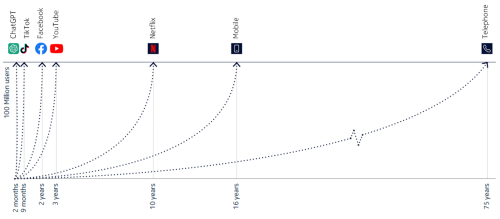
Figure 1. Time to reach 100 million users for various applications
click to enlarge
While today’s industry conversation understandably gravitates toward massive GPU infrastructure buildouts, it’s essential not to overlook the network's pivotal role. The cloud, in its very essence, exists because of the network. Its evolution, whether supporting IP video or the surge of AI workloads today, is inextricably linked to the network's own advancement. The network will ultimately serve as the gating factor for how far AI and cloud technologies can truly evolve.
AI's insatiable appetite for data
Just as the video wave dramatically reshaped network traffic patterns and architecture, the AI wave is poised to do the same.
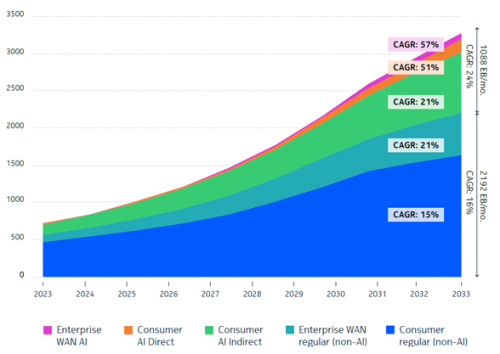
According to Bell Labs Global Network Traffic report, wide area network (WAN) traffic is forecast to reach 3,386 exabytes per month by 2033. A substantial portion of this (1,088 exabytes) is attributed to AI traffic alone, which is projected to grow at a compound annual growth rate (CAGR) of 24 percent (Figure 2).