
Reinventing Endpoint Management: The 10-in-1 Architecture for the Modern Enterprise and MSP
By: Koroush Saraf - Advisor, Zerotouch.ai

In today's hyper-connected world, cybersecurity demands a holistic approach that encompasses network security, endpoint security, and cloud security. Companies like Palo Alto Networks and Fortinet have excelled at fortifying the network perimeter, while endpoint protection platforms such as CrowdStrike and Microsoft Defender have focused on detecting and responding to threats at the device level. Yet, a critical gap persists: the lack of comprehensive endpoint lifecycle management. This oversight leaves organizations exposed, creating fertile ground for successful cyberattacks. And threat actors increasingly exploit endpoint-level vulnerabilities in addition to attacking the network perimeter.
The problem is systemic. Without proactive management throughout an endpoint's lifecycle—from provisioning and patching to decommissioning—vulnerabilities accumulate. Unpatched software, outdated drivers, and unmanaged applications become entry points for malware, ransomware, and advanced persistent threats. Traditional endpoint security tools are reactive, kicking in only after a threat is detected. But prevention requires more: ongoing maintenance that ensures devices are hardened from the start and remain secure over time.
The Fragmentation of Legacy Tools
Enterprises and managed service providers (MSPs) often rely on a patchwork of legacy tools to handle endpoint management. A typical stack might include Intune for Windows and mobile devices, Jamf for Apple ecosystems, remote access solutions like TeamViewer or AnyDesk, deployment tools such as PDQ Deploy or Chocolatey, update systems like WSUS or SCCM, various RMM platforms, and a slew of custom scripts to fill the gaps.
This fragmentation breeds inefficiency. Tool sprawl leads to siloed data, where insights from one system don't inform another. IT teams face operational fatigue, juggling multiple interfaces and logins. Security gaps emerge as policies inconsistently apply across operating systems—Windows, macOS, iOS, Android, and ChromeOS. Costs balloon from overlapping subscriptions, while complexity slows down responses to incidents.
The outcomes are inconsistent at best. Onboarding drags on, patches miss deadlines, and compliance audits reveal blind spots. If your endpoint strategy is still a patchwork of RMM, MDM, and scripts, you’re already behind.
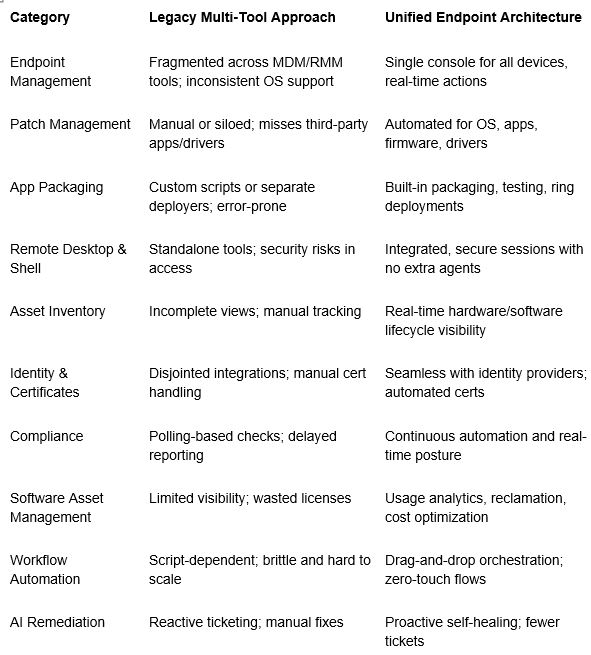
Table 1 - Unified end-point architecture vs. legacy, multi-tool approach
click to enlarge
The Amplified Challenges for MSPs
For MSPs, these issues are magnified by the nature of their business. Managing multi-tenant environments means dealing with diverse client needs, often requiring different tools per customer. This leads to high per-device costs, as licenses and agents multiply across stacks.
Scaling becomes a nightmare. Adding clients demands more staff to handle the tool complexity, eroding margins. Service level agreements (SLAs) suffer when remediation takes hours instead of minutes, and customer satisfaction dips amid frequent disruptions. MSPs need consolidation to streamline operations, reduce overhead, and deliver consistent value—without sacrificing security or control.