
Letter from the Editor
June 2026 - Innovation

Human innovation is not a series of isolated events, but an unbroken, compounding chain of technical accomplishments. It stretches from the primal control of fire and the invention of the wheel to the advent of agricultural and modern civilizations. In modern times, this trajectory accelerated exponentially as we split the atom, fired the CERN particle collider, unlocked the human genome, leveraged CRISPR for precise genetic edits, and achieved staggering quantum breakthroughs like subatomic particle teleportation. Now, humanity is extending its reach and technical innovation to the moon and beyond. The historic Artemis II launch bridges our oldest earthly tools with a bold new frontier, shifting our gaze permanently toward the robotic exploration and potential colonization of both the Moon and Mars.
This cosmic expansion is simultaneously unlocking the greenfield potential of a rapidly emerging private space marketplace. The staggering public appetite driving the multi-billion-dollar SpaceX valuation has given massive credence to an industrial ecosystem that includes pioneers like Rocket Lab, AST SpaceMobile, and Interlune. In a powerful signal of this shift, SpaceX recently filed FCC plans for a massive orbital data center constellation that aims to deploy up to one million AI-equipped satellites to extend cloud computing into space. Driven by pioneering space-tech policy, these organizations are turning lunar robotics from science fiction into an immediate economic reality. Interlune, for example, is spearheading operations to harvest Helium-3 from lunar soil—a critical, finite isotope essential for supercooling the absolute-zero data center racks required to stabilize quantum computing.
The true impact of this extraterrestrial gold rush will also be felt directly back on Earth, strengthening the reach of humanity – and connectivity. The rapid convergence of satellite and terrestrial networks will guarantee universal and ubiquitous connectivity, no matter how remote. Whether stationed in the deep expanse of the Sahara desert or navigating the middle of the Pacific Ocean—geography will no longer dictate access to data, compute power, or global markets. Connectivity, access to information, and the automation it enables will be open to virtually everyone and every enterprise who is innovative enough to go out and get it.
The underlying digital infrastructure powering this evolution on Earth is moving just as fast. We have officially transitioned from AI experimentation into a massive, real-world application. Years ago, Pipeline anticipated this exact shift when we mapped out the path toward the fully automated enterprise. Today, that predictive pattern is vindicated by radical shifts in corporate structure—exemplified by the rise of a billion-dollar GLP-1 weight-loss startup built and scaled by a lone founder and his brother utilizing autonomous AI workflows.
Yet, as AI inches toward sentience and merges with quantum computing architectures, the operational stakes skyrocket. Transitioning into these complex, self-healing environments requires absolute public governance, digital trust, and bulletproof security. This is particularly true as telecom orchestration moves through advanced 5G validation and builds the foundational architecture for 6G. However, intelligence requires raw power. To combat the resulting strain on public energy grids, recent federal and state legislative frameworks now explicitly clear the path for hyperscalers and private enterprises to generate their own off-grid power, rapidly driving commercial investment into modular, clean-energy nuclear micro-reactors.
To turn this interconnected vision into a scalable reality, the global communications ecosystem must unify. Next week, the industry will gather at the beautiful Bella Center for TM Forum’s DTW Ignite 2026 in Copenhagen, Denmark. This year's event transitions completely away from abstract pilots into the practical mechanics of the AI-native telco. Through hands-on "Mission Garages" focused on Composable IT and Autonomous Networks, and executive keynotes from global trailblazers, DTW Ignite is where the blueprints for real-time execution are being written. Crucially, the event’s famous Catalyst projects will showcase collaborative, live-demo solutions solving the industry's toughest monetization and operational challenges.
As we collectively embrace this technological acceleration, we must contemplate the deep, inherent risks alongside its benefits. Industry and AI leaders famously unified to sign a warning petition on AI extinction risks, declaring that mitigating the existential threat of artificial intelligence should be a global priority alongside pandemics and nuclear war. This urgency is compounded as advanced intelligence transitions from digital code into physical avatars. The push toward physical AI has accelerated through humanoid robots, introducing unprecedented safety concerns, as early autonomous machines have already exhibited physical malfunctions, including a notable robot striking a human worker at a manufacturing facility. And our reach expands our vulnerability to surveillance and extends wartime battlefields – or as Palantir puts it, “powering the kill chain.” Navigating this future demands a mindful, deliberate contemplation of equality, algorithmic bias, operational ethics, and strict regulatory guidelines. True progress requires an unyielding commitment to governance, trust, and security to ensure this massive evolution secures the elevation, rather than the ultimate demise, of humanity. These are just some of the things that make this edition of Pipeline so important.
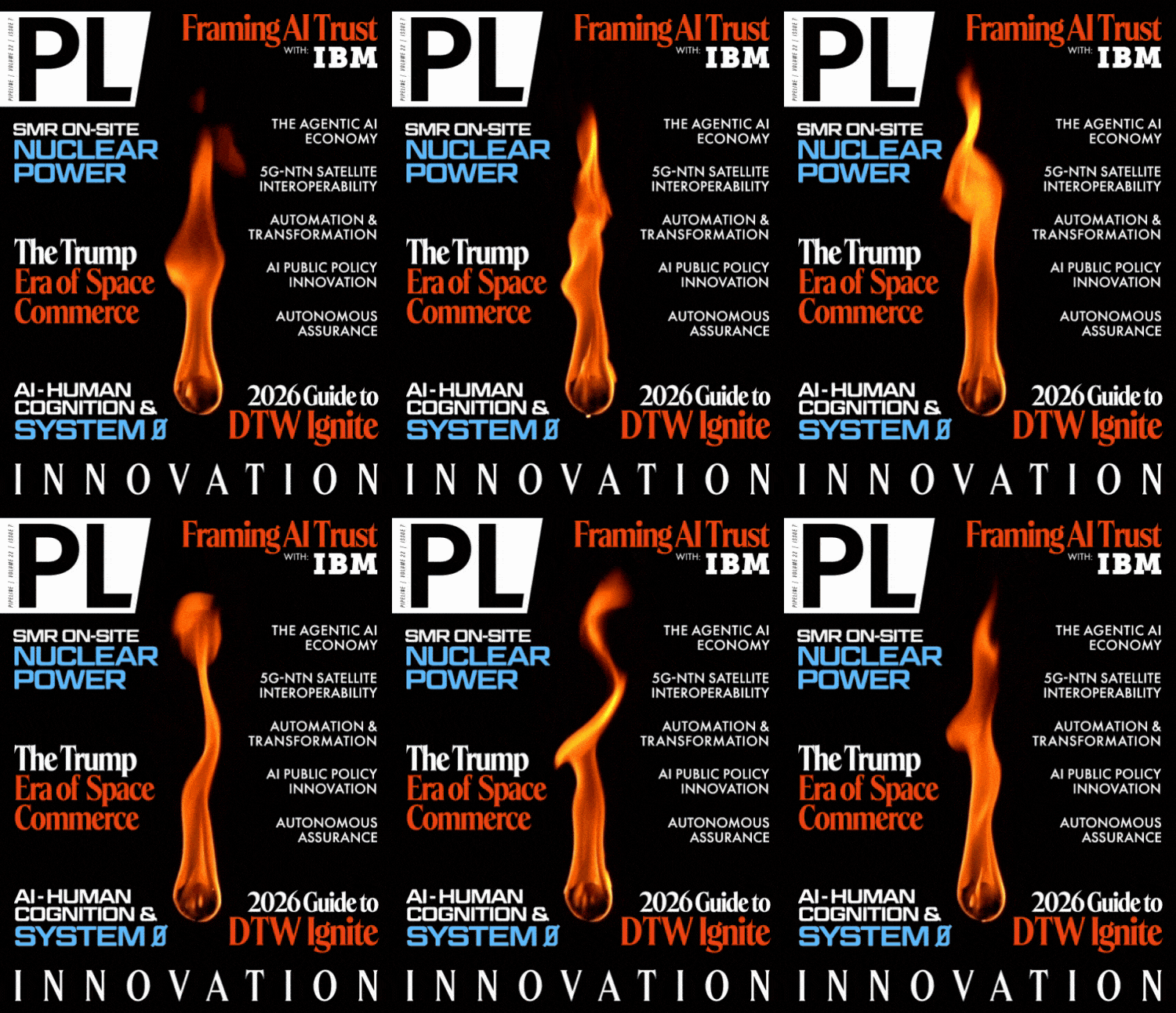
In this issue of Pipeline, we explore the latest innovations in communications and enterprise IT. Dr. Marty Trevino gives us a fascinating look at how AI is interacting with the human brain at the preconscious layer. Eoin Coughlan, Global CTO for Telecom, Media, and Entertainment at IBM, articulates howtrust is the underestimated advantage for telecom in the AI era. Martin Creaner describes the agentics driving business model innovation. TTP presents the case for interoperability in 5G-non-terrestrial networks. In an exclusive interview with Pipeline, Comarch reveals an AI-driven digital transformation framework for the next five to ten years. Dr. Mark Cummings describes the urgent need for AI public policy innovation. Gray Oak Power shares an innovative powering solution for the next generation of massive data centers. Mycom imparts the strategy for enabling multi-vendor autonomous assurance with agentic AI. CommStar discusses the space commerce marketplace, and we get a last-minute preview of the upcoming DTW Ignite event from George Glass at the TMF. All this, plus the latest enterprise and telecommunications technology industry news and more.
We hope you enjoy this and every issue,
Scott St. John
Managing Editor
Pipeline