

The Need for AI Public Policy Innovation

While AI technology innovation powers ahead, AI public policy is trailing. There is a growing consensus that society will have to make adaptations to AI. But little work on how to do that. Innovation in hardware, software, and applications is moving ahead rapidly. There is a chorus of people talking and writing about what AI will do to us, but little work on possible actual responses or scenarios of effects and responsive adaptations. That needs to change. Having a range of scenarios to discuss and places to have those conversations is the best way to encourage the public policy innovation we need. Waiting to build life jackets until we are already in the water is dangerous.
Hardware, Software and Application Innovation Background
We are in the middle of a 10X step. NVIDIA’s Rubin and competing chips are powerful, but not powerful enough for the next !0X step in frontier model size. We will see the next generation of chips and the new architecture of data centers/infrastructure to support them circa 2028. Then, those 10X larger models will start training the next generation. The new hardware and models will lead to dramatic improvements in software. Past 10X experience tells us that the improvements are hard to predict. But likely to be dramatic.
Meantime, the frontier model companies are making progress in software, driving new capabilities such as Mythos.
In the applications space, intelligent agents have caught fire. OpenClaw poured fuel on the fire, followed by a wave of intelligent agent innovators and innovations.
Components of Public Policy
A lot of current public policy discussions revolve around regulation. There are many possible levels of regulation, both geographic and industry segment. Geographic ranges from international to national to regional to local. Functional tends to focus on industry segments such as medical, utilities, autos, etc. Regulations can tell companies what they have to do, what they can’t do, and set economic parameter values such as profit, investment, etc., percentage, and certain behavioral goals.
Understanding regulation is important in considering public policy. However, regulation is not the only part of public policy. Other non-regulatory components of public policy include felony law, civil law, sanctions, taxation, loans, grants, incentives, jawboning, etc. These can be as powerful, or even more powerful than regulations.
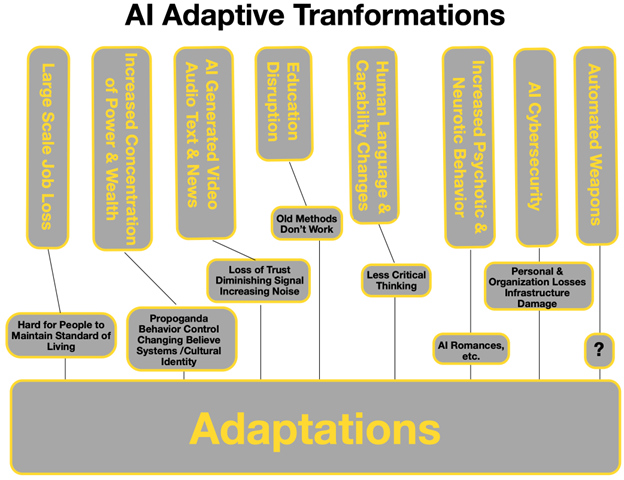
Adaptation Areas Overview
The illustration in figure 1 shows the adaptations that society must make for AI. There has been a lot of attention recently on the potential job loss problem and how our education systems must change to function in the AI environment. The dispute between Anthropic and the US DoD has highlighted the autonomous weapons area. Mythos has raised attention on the cybersecurity challenge. One can feel the rumble of resentment with AI increasing the wealth and power gap. There is also concern being expressed about: psychotic behavior and AI; Deep Fakes making it hard to determine what is true; impacts on our language and cultural materials.