
Designing Pervasive Mobile Networks
Through Multi-Modal Architecture
Examples of this broader industry maturation include the continued expansion of Starlink services and the progression of Amazon’s Amazon Leo constellation...
managed through discrete failover events, but through continuous optimization across all available paths. By treating each access method as active and contributing, traffic can be balanced,
aggregated, or adjusted at a granular level in ways that remain invisible to applications and users, avoiding the session interruptions commonly associated with traditional primary and secondary
models.This architectural mindset represents a departure from traditional network planning. Instead of asking which access technology is best, the more relevant question becomes how different access technologies work together to support continuity.
Integrating Non-Terrestrial Connectivity
Non-terrestrial connectivity, particularly in the form of modern satellite systems, has long been part of multi-modal network design discussions, especially for environments where terrestrial
infrastructure is limited, unreliable, or operationally constrained. What is changing is not the architectural role of satellite connectivity, but its scale, accessibility, and degree of
integration into mainstream network planning. As non-terrestrial capabilities mature, they are increasingly evaluated alongside cellular, private wireless, and fixed access options as a standard
design consideration rather than an exceptional case.
Examples of this broader industry maturation include the continued expansion of Starlink services and the progression of Amazon’s Amazon Leo constellation into enterprise business testing, reflecting how non-terrestrial connectivity is becoming a normalized component within multi-modal architectures rather than a specialized workaround.
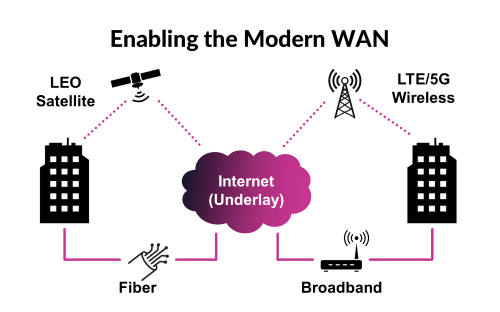
Figure 1: Today's Multimodal WAN
The most effective use of non-terrestrial connectivity does not treat it as a replacement for terrestrial networks. Instead, it is integrated as an additional access layer that enhances
resilience and reach. This perspective is increasingly reflected in operator-led analysis, which frames direct-to-device satellite services as a complement to existing mobile networks rather than a substitute,
given practical constraints related to capacity, indoor performance, and spectrum economics.
When integrated thoughtfully, non-terrestrial connectivity introduces diversity into the network. It reduces reliance on any single infrastructure type and enables continuity when localized
failures occur. This diversity is especially valuable in scenarios where physical infrastructure is vulnerable to environmental, geographic, or operational disruption.
Resilience Across Operating Environments
While the drivers for pervasive mobile networks vary by sector, they converge around a shared need for resilience and adaptability.
In the public sector, connectivity underpins safety, coordination, and continuity of operations. Emergency response, disaster recovery, and critical services often operate in environments where infrastructure is damaged or overloaded. In these situations, communications must remain available across agencies, locations, and mobile units. Networks designed with multiple access paths are better positioned to maintain continuity even as individual components fail or degrade.