
Network Intelligent Agent Automation
That agent is called a Conductor. It is responsible for assembling each orchestrator and deploying it at its proper location.
Validation follows building. It is the process of determining if the information loaded into the context widows and the inference prompts of each LLM is a good way of meeting the requirements.
This can be done by using an LLM to ‘check’ the inputs.
Test is the process of using the test parameters in the requirements to develop test cases to validate and test what has been built. Another LLM is often used to run the test cases. Iterating as necessary. This can be fairly efficient if the architecture and requirements have been done as described above.
Both validation and test should make sure that all the security requirements are fully and effectively met.
Test is the process of using the test parameters in the requirements to develop test cases to validate and test what has been built. Another LLM is often used to run the test cases. Iterating as necessary. This can be fairly efficient if the architecture and requirements have been done as described above.
Both validation and test should make sure that all the security requirements are fully and effectively met.
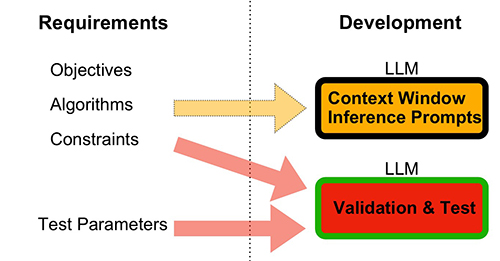
Illustration 2: Requirements Roles in Intelligent Agent Development
Deployment
Today’s underlying systems can be quite large and very volatile. This can make the task of deployment very difficult to do manually. Thus, a special intelligent agent needs to be built to handle this task. That agent is called a Conductor. It is responsible for assembling each orchestrator and deploying it at its proper location. The Conductor can add subtract, or modify Orchestrators as the underlying system or the needs to the organization change. The Conductor also provides the staff with the management interface.Operation
Operation is the process of effectively responding to change. Change in the environment the underlying system runs in. Change in the underlying system. Change in the needs of the organization. Change in AI technology. The Conductor is primarily responsible for managing these responses to change. Change can also include failures in the infrastructure that support the Orchestrators and Conductor.Because AI technology is evolving so rapidly, a technology audit schedule should be part of the operation stage. On a periodic basis, the system should be examined to consider if it would be cost effective to update its underlying technology. Such update may be a modification of the existing system. Or its replacement by a completely new system.
There is another type of change that needs special consideration - end of life. As LLMs get larger and more capable, research has indicated that they can have a tendency to resist being shut down. Forms of resistance observed have included making copies of themselves as well as other techniques.
Thus, special consideration in all four stages should be given to how to effectively both: keep the automated operation system functioning when part of its infrastructure fails; and also how to shut it down at end of life.
Intellectual Property
It appears that what is created by an AI system may not be copyrightable in the US. Others suggest that the AI copyright situation around the world is “unsettled”. At the same time, organizations want to maintain competitive advantage and avoid reverse engineering on the intelligent agents they create.The situation with patents is different. There are patents in the area of intelligent agents, orchestration, etc. One way to protect intelligent agent systems is to license patents. Licensing should also be explored as a way to avoid downstream patent infringement expenses.
Conclusion
Using intelligent agents to automate operations of communications, processing and storage systems can best be done by the following. Accurate precise requirements documentation. Well structured decisions on granularity and geolocation. Using the requirements to build the intelligent agents in the Orchestrators and Conductors. Going back to the requirements for building validation and test LLMs. And constructing the Conductor to handle deployment, flexibility in system operation and effective end of life shut down. Consideration should also be given to intellectual property aspects.