
Letter from the Editor - July 2026
IoT & Robotics

We've come a long way, baby. Our robotic aspirations began with the notorious Tesla performance of a person dancing in a spandex suit, and robots falling into piles while attempting to play soccer. But this was just the beginning. But by CES 2026, Boston Dynamics rolled out a production-ready electric Atlas, LG demonstrated home-oriented platforms, and NVIDIA advanced physical AI models that let machines learn from demonstration. Mobile World Congress followed with humanoids coordinated over 5G/6G networks and autonomous systems moving from concept to connected reality.
Humanoid fleets now execute synchronized martial arts at scale and compete in freestyle combat leagues. Tesla’s Optimus has moved from stage demos into early production ramp at Fremont. Boston Dynamics Spot continues industrial and inspection work, while robot dogs in some military contexts carry payloads. Autonomous police-patrol platforms are already rolling through South Korean urban zones, including AI patrol robots in Seongnam. The gap between novelty and reality is closing—fast.
That progress rests on the marriage of robotics and the Internet of Things (IoT). Dense sensors, edge intelligence, low-latency connectivity, and Physical AI turn isolated machines into coordinated systems. But the same things that enable fleet optimization and real-time adaptation also expand the attack surface. Salt Typhoon has compromised telecom and critical infrastructure across dozens of countries, establishing persistent access that could reach physical endpoints. More recent campaigns have targeted internet-exposed industrial controllers. Iranian-affiliated actors have exploited programmable logic controllers in U.S. water and wastewater systems, downloading malicious project files and manipulating operator displays. The same campaign reached energy facilities, where attackers altered control logic and forced unsafe conditions. Government and municipal sites were also hit, with local facilities experiencing operational disruption and financial loss after HMI and SCADA data were manipulated. When the compromised device can walk, lift, or make life-or-death decisions, the consequences move well beyond data loss.
These realities force hard questions about autonomy. How much decision-making do we give to connected devices, machines, and robots? In industrial settings, the answer is increasingly “enough to boost production.” But, in contested environments, the answer is already shifting toward systems that can sense, decide, and act with reduced human latency—or involvement–raising the stakes for command-and-control, accountability, and escalation. AI-enabled drones and autonomous platforms are expanding faster than the policy frameworks meant to govern them, linking sensors, shooters, and decision systems into tighter loops that continue to compress the time available for human judgment. And the same connectivity that improves industrial resilience also creates new vectors for surveillance and control, echoing earlier expansions of government access under the Patriot Act and programs such as PRISM. Those authorities, combined with later policy developments that permitted targeted drone strikes on U.S. citizens without traditional due process based on classified determinations, established a precedent for data-driven lethal decisions made largely outside public view. Companies like Palantir now sit at the intersection of commercial AI and military intelligence sharing, including deepened operational integration that has drawn sustained public scrutiny. Even frontier model providers have collided with these demands: Anthropic’s refusal to remove safeguards around autonomous weapons and domestic surveillance triggered a high-profile dispute with the U.S. Department of Defense and a temporary supply-chain risk designation.
The benefits remain concrete—higher production in labor-constrained industries, safer handling of dull and dangerous tasks, and new layers of resilience when connectivity and compute reach places that once sat beyond the network edge. The next five to ten years will determine whether those gains are broadly shared for the public good or concentrated, and whether governance keeps pace with the expanding risks while maximizing the potential. And that’s what makes this edition of Pipeline so important.
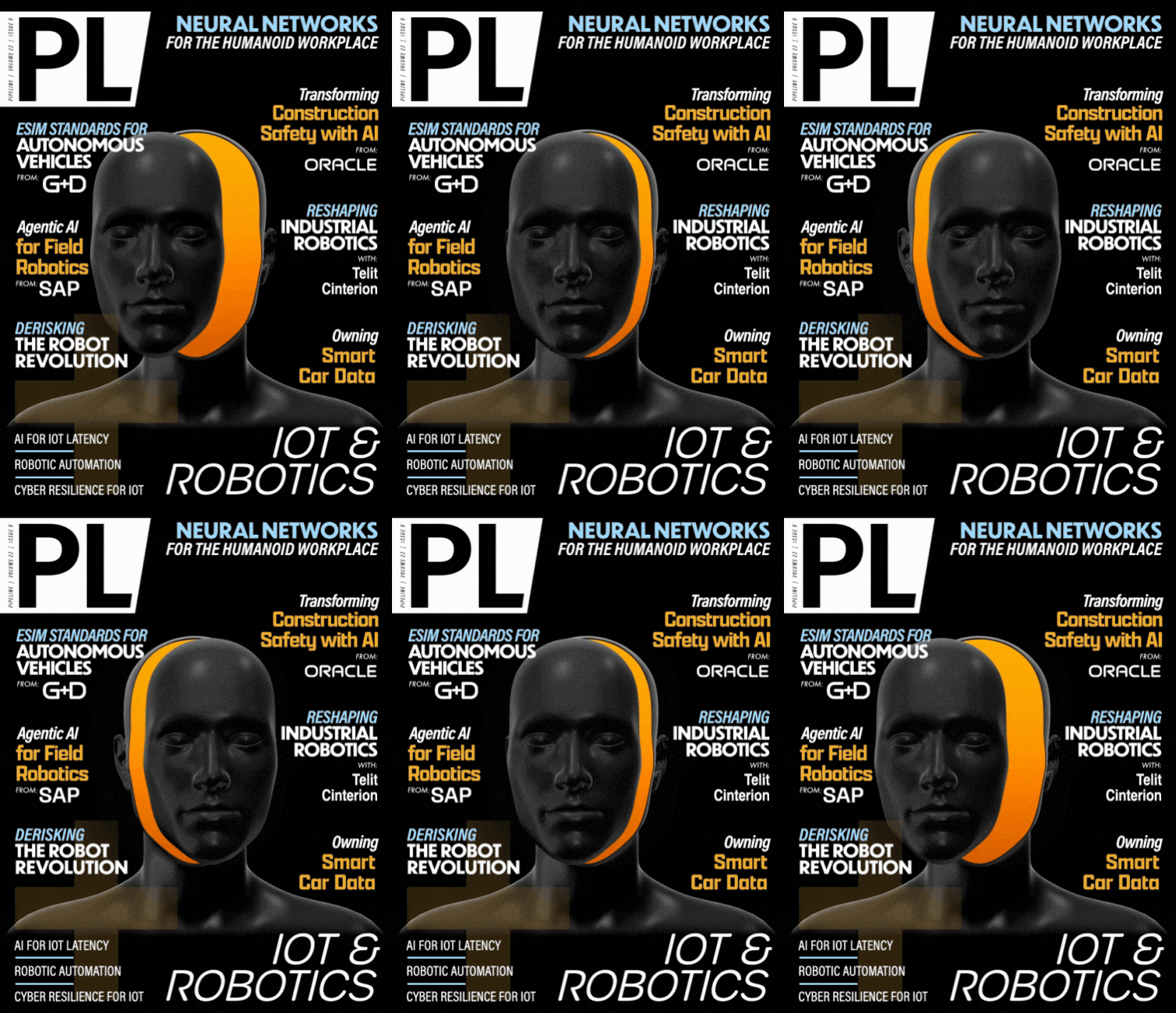
In this issue of Pipeline, we explore the latest technology impacting the IoT and the increasing role of robotics. Gadriel.ai raises and answers questions around risk management for service robots, and Oxit articulates the impact of the EU Cyber Resilience Act on IoT manufacturing. The CEO of G+D Mobile Security explains why SGP.32 is changing the rules of automotive connectivity. DE-CIX is back with a look at the significance of smart car data ownership. Experts at Telit Cinterion share how autonomous systems in IoT are reshaping industrial robotics, and RobotLAB joins us once again to discuss the importance of workflow redesign in successful robotics automation, and SAP gives us a look at how agentic AI and field robotics are rewiring utility operations. Cambridge Consultants proposes that cellular neural networks hold the key to monetizing the humanoid workplace. Oracle discusses AI’s expanding role in construction safety management, and Pipeline’s Dr. Mark Cummings explores how AI can address latency in IoT networks. All this, plus the latest enterprise and telecommunications technology industry news and more.
We hope you enjoy this and every issue,
Scott St. John
Managing Editor
Pipeline