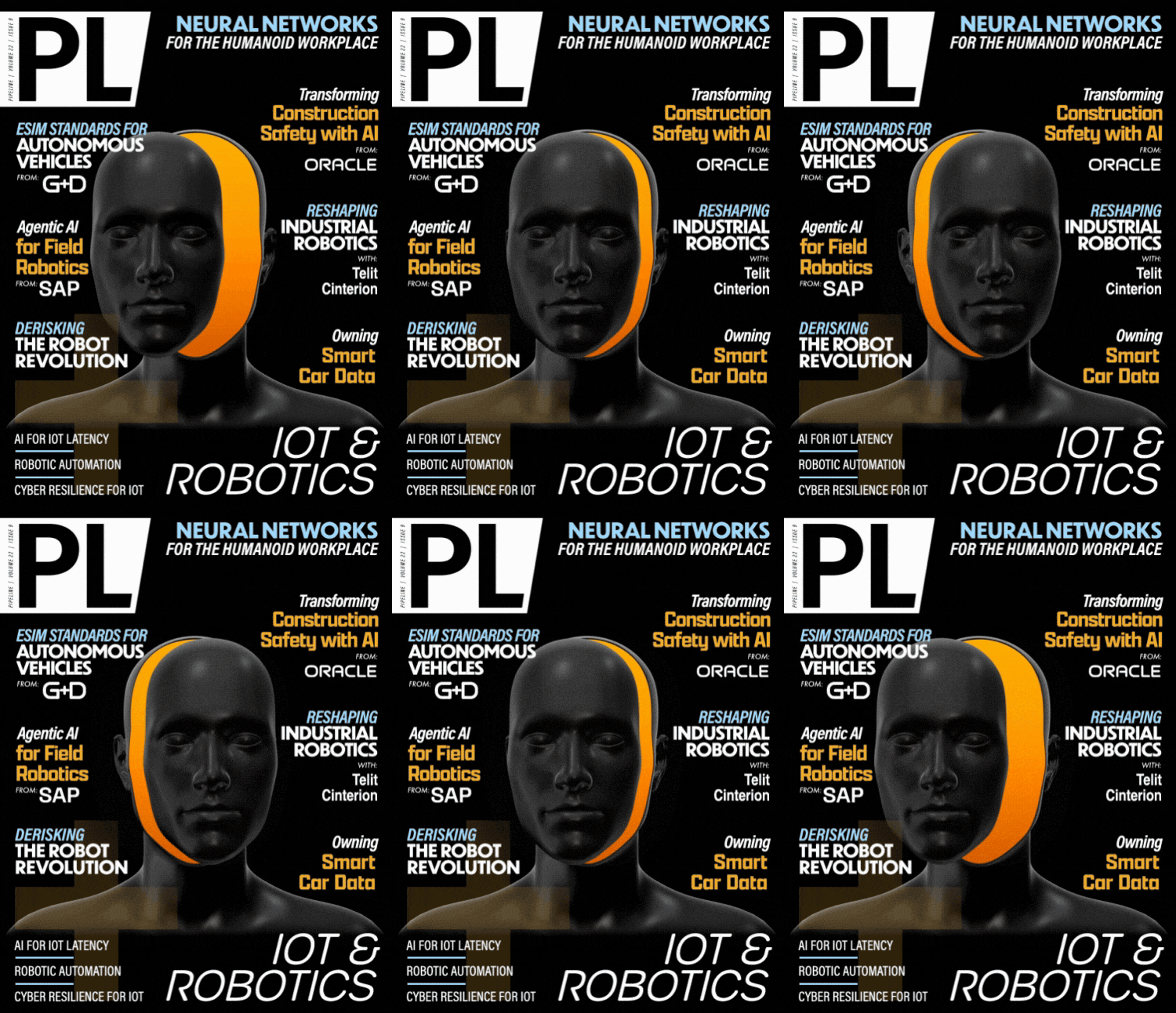

From Connected Devices to Autonomous
Systems: How IoT Is Reshaping Industrial Robotics
By: Marco Argenton

As robotic systems become more autonomous, connectivity is no longer a peripheral design choice. It becomes part of the control architecture that determines how robots communicate, localize, authenticate, update and operate across changing environments.
In many industrial and mobile robotics deployments, the challenge is not simply adding a cellular module or a wireless interface. The challenge is integrating multiple capabilities — cellular connectivity, GNSS, Wi‑Fi, Bluetooth, secure identity, certification, provisioning and lifecycle support — into a reliable subsystem that can be deployed across product variants and geographies.
This creates a shift in value from discrete components to pre-integrated connectivity platforms. A robotics OEM may not want to manage separate suppliers for radios, positioning, antennas, SIM/eSIM, security elements, certifications and network approvals. Instead, a pre-certified and lifecycle-managed connectivity subsystem can reduce integration burden, shorten deployment cycles and improve reliability in the field.
For industrial robotics, this is especially relevant as autonomous systems move beyond fixed production cells into warehouses, yards, agricultural environments, healthcare settings and mission-critical infrastructure. These environments require resilient connectivity across private and public networks, secure device identity, precise positioning and long-term support. In this context, connectivity becomes an enabling layer for autonomy rather than a commodity feature.
This evolution also changes how robotics platforms are evaluated. Mechanical performance and onboard intelligence remain essential, but increasingly they must be supported by secure, trusted and maintainable communication architectures. The organizations best positioned to support this transition will be those able to combine embedded connectivity, security, certification expertise and lifecycle execution into a scalable platform model.
From Deterministic Control to Adaptive Behavior
Traditional industrial robots were designed around deterministic control systems. Tasks such as welding, assembly and material handling were optimized for consistency, with motion paths and parameters defined in advance. Any deviation from expected conditions required manual intervention, including reprogramming or recalibration. This approach constrained robotics to environments where variability could be minimized.
The integration of connected sensing and machine intelligence introduces closed-loop feedback mechanisms that fundamentally alter this model. Sensors embedded within equipment and the surrounding environment continuously capture variables such as force, vibration, temperature and spatial positioning. These data streams are analyzed in near real time, allowing robotic systems to adjust their actions dynamically.
For example, instead of following a fixed trajectory, a robot can modify its movement based on subtle changes in part alignment or material properties. Similarly, in handling applications, grip strength can be adjusted in response to detected differences in weight or surface conditions. These capabilities reflect a shift from static execution to adaptive behavior, where systems refine their performance continuously based on live feedback.
Data Pipelines as a Control Layer
Data is central to this evolution, but its role extends beyond simple collection. Industrial environments now generate high-frequency telemetry that must be ingested, filtered and transformed into actionable inputs. This has led to the emergence of structured data pipelines that support real-time decision-making.
In these architectures, raw sensor data is first captured and normalized to ensure consistency across devices. It is then processed through analytics and inference