
Cellular Neural Networks Key to
Monetising the Humanoid Workplace
By: Frank Long, Dr. Ali Shafti
Across the global mobile network landscape, intensifying market competition and stagnating traditional revenue lines are squeezing operators directly in the middle. To break free from this
commodity trap, carriers have spent years searching for enterprise use cases that propel them up the value chain beyond connectivity.
The commercialisation of Physical AI, specifically the deployment of robotic labour within the human workforce, offers an opportunity for telcos to take a controlling position early in what is
promising to be a large and valuable market.
As these robots step beyond physically impressive demos onto unmapped factory floors, logistical hubs, and medical centres, they hit a critical wall. The emerging bottleneck to scalable humanoid
robotics isn’t mechanical design; it is the limits of on-robot intelligence, which is greatly enhanced by shifting cognition to low-latency networks hosting edge AI, what could be described as
distributed intelligence.
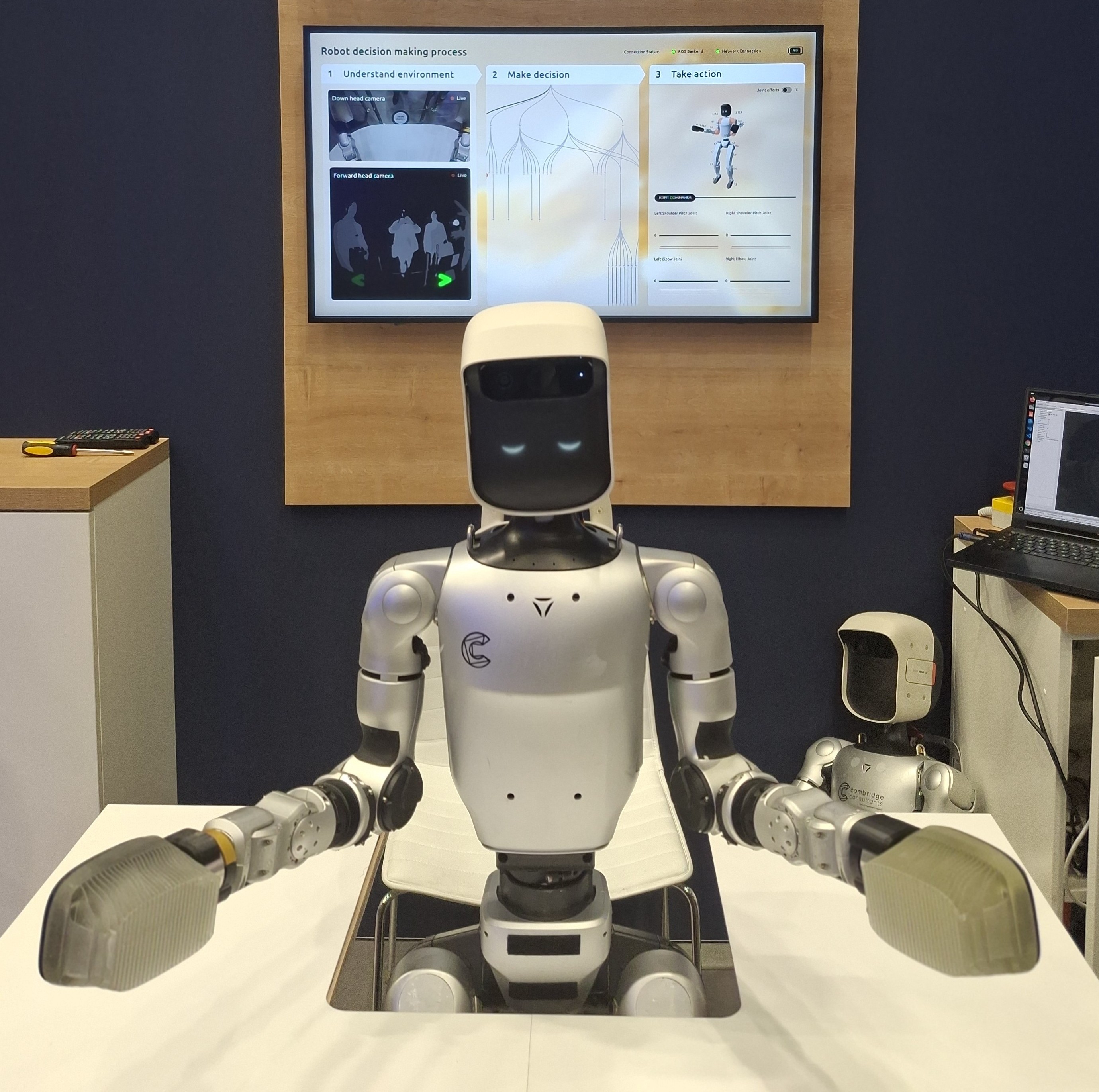
At Mobile World Congress this year, a live physical AI demonstration in the Capgemini stand featured an advanced humanoid robot. It didn’t breakdance or perform flying kicks; instead, it moved
boxes indicated by a human operator from one place to another. By performing real-time task decision making and understanding of natural human behaviour, the system didn't just capture the
attention of enterprise architects - it secured a Tom's Guide “Best in Show” award for its groundbreaking capabilities. The cognitive intelligence to enable those capabilities wasn’t on the
robot; it was provided via edge AI, connected to the robot via a network link.
By combining intelligence from the network with the emerging Human-Machine Understanding (HMU) models, validated by this showcase, telecommunications operators can claim their position as the
foundational operational backbone of tomorrow’s autonomous labour market. But there are a few challenges to overcome first.
The deep tech triad of collaborative labour
Deploying mobile, autonomous humanoids alongside human workers requires seamlessly blending three distinct technology vectors into a single, real-time control loop:
Physical AI: Machine learning models integrated into physical forms that must run complex neural networks for spatial computing, object grasp mechanics, and dynamic balance
adjustments simultaneously.
Human-Machine Understanding (HMU): The crucial behavioural layer that allows a robot to interpret human intent and support them effectively. Rather than executing rigid code, HMU
continuously monitors the operator, the environment and the task at hand to allow safe and trusted real-time collaboration.
Network Automation: The automated software layer that dynamically provisions cellular pathways, guarantees dedicated bandwidth slices, and balances intense computing workloads so
critical safety loops never experience packet drop or jitter.
In practice, this triad creates a high-stakes control loop paradox. If a humanoid worker encounters an unexpected human movement in a shared warehouse aisle, its HMU layer must instantly flag the
shift in intent. To guarantee safety, this contextual data must be offloaded via an automated network slice to a local edge server, which recalculates the robot’s physical movement path in
milliseconds. If any link in this network fabric lags, the physical AI fails, potentially turning an expensive enterprise asset into an immediate industrial hazard.
Distributed Intelligence: moving the brain to the edge
For enterprise buyers, one of the most pressing engineering challenges holding back humanoid fleets is the balance between physical payload, battery life, and local compute costs. Packing enough
raw GPU power directly onto a humanoid to handle all the cognitive, motive, and planning functions required to successfully execute tasks adds weight, heat, and cost to each individual
robot.
The path to commercial scalability requires a distributed intelligence architecture. As demonstrated with the MWC award-winner, the humanoid’s onboard systems should handle immediate, low-latency
reflex controls, while heavy processing tasks - such as high-fidelity semantic mapping, task planning, and deep HMU behavioural analysis - are offloaded to edge AI nodes hosted by the
operator.
To make distributed intelligence a reality, MNOs must deliver highly reliable intelligence from the network, designed around three major technical criteria:
The connectivity dependency: Offloading intelligence to the network demands that the network is always available. 5G can provide the mobility, QoS guarantees, and
high-performance throughput required to maintain continuous and safe operations. Achieving this drives the need for intent-driven network slicing to dynamically isolate and prioritise traffic.
Telemetry data for decision making requires minimal bandwidth but absolute, zero-failure latency guarantees. Conversely, contextual video logs can absorb minor transmission delays but require
heavy throughput.