
Rise of the Robots: You Wouldn’t Let a
Stranger Roam Your Building. Why Let a Robot?
By: Koroush Saraf
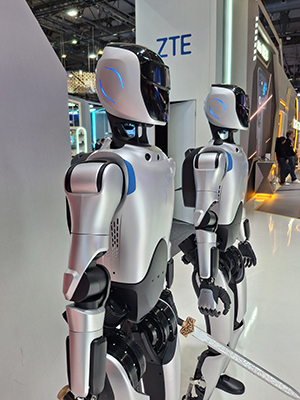 Walk into any modern warehouse, hospital, hotel, airport, campus, or corporate lobby, and you will increasingly find a non-human colleague.
A floor-cleaning robot navigating the atrium.
An autonomous delivery cart moving supplies.
A security drone patrolling the perimeter.
A robotic kiosk greeting visitors.
A connected machine performing work that used to require a person.
An autonomous delivery cart moving supplies.
A security drone patrolling the perimeter.
A robotic kiosk greeting visitors.
A connected machine performing work that used to require a person.
We have decided, almost overnight, that autonomous machines belong inside some of our most sensitive physical spaces. What we have not decided is how to vet them.
That gap should concern every enterprise leader, network operator, security team, and risk officer.
Consider how seriously we treat human access. No serious organization lets an unbadged stranger walk freely through its facilities. We run background checks. We issue credentials. We restrict
access by role. We log entry and exit. We assume, correctly, that physical presence inside our walls is a privilege that must be earned and continuously verified. Then we wheel in a
200-pound autonomous machine packed with cameras, microphones, sensors, motors, network radios, cloud connectivity, and a software stack most enterprises have never inspected — and we plug it in.
No background check.
No behavioral credentialing.
No independent validation.
No clear view into what it senses, where it sends data, what commands it can receive, or what it does when no one is watching.
This is essentially an unmanaged, third-party operational technology risk. And it is about to become a very expensive one (for whom?).
The threat is not hypothetical, and it comes from three directions at once.
The first is the vendor. A robot you purchased is often still, in a meaningful sense, theirs. It phones home. It receives updates. It sends telemetry. It may depend on a cloud backend, a mobile app, a remote support tunnel, or a fleet-management API that the enterprise does not control. That means the vendor, intentionally or unintentionally, has a path into your facility. In some cases, so do the vendor’s subcontractors, cloud providers, support teams, and software supply chain.
The second is the attacker. Many connected machines are deployed like ordinary equipment, but they are not ordinary equipment. They are mobile computers with sensors, actuators, and network access. Some run aging operating systems, open-source robotics middleware, exposed APIs, weak authentication, poorly segmented connectivity, or remote access functions designed for convenience rather than security. If an attacker compromises a fleet-management platform, cloud API, update channel, or command-and-control path, the result is not just a data breach. It can become a coordinated physical intrusion.
The third, and most underrated, is the accident. Autonomous systems fail in ways their makers did not fully test. A navigation model misreads an edge case. A sensor is spoofed. An actuator fires at the wrong time. An AI system interprets a command too broadly. A robot behaves correctly according to its internal logic, but dangerously in the real world. These failures do not require malice to create harm.
That is what makes robots different from laptops, cameras, or access points. A compromised robot can observe, move, block, carry, damage, distract, and interact with the physical world. It is not just another endpoint. It is an endpoint with a body and capabilities.
The robot is the tip of the iceberg
The robot is only the visible version of a broader problem. The same issue is already entering the enterprise without wheels.Autonomous AI agents are being connected to CRM systems, support platforms, code repositories, databases, financial workflows, HR systems, ticketing systems, and operational tools.