
Letter from Editor
Ubiquitous connectivity and pervasive mobility, something we coined and have been talking about for over five years, is no longer just a concept. 5G non-terrestrial networks have gone from PowerPoint to production: Starlink’s direct-to-cell service is live nationwide in the US and Europe, AST SpaceMobile’s BlueBird satellites beam broadband from orbit, and regulators worldwide are carving out spectrum for seamless satellite-terrestrial convergence. The result is that a miner in the Australian Outback or Arctic, and an oil tanker in the Atlantic, can now enjoy the same connectivity as a trader in Manhattan or a Silicon Valley tech company, indicating global IoT has become a viable industry use case.
Quantum has also left the laboratory and entered real-world deployments. Major organizations are running post-quantum cryptography pilots because the math is unforgiving, and the day quantum computers can break government-grade encryption—known as Q-Day—is fast approaching. Credible estimates place Q-Day in the 2030s, with some aggressive forecasts as early as 2028–2030 for weaker keys, according to the Global Risk Institute 2024 report. NIST, the NSA, and IBM all urge migration by 2035. Something we’ve been sounding the alarm on for years. In fact, “Harvest Now, Decrypt Later,” as detailed by Palo Alto Networks, is already underway. Nation-state adversaries are stockpiling encrypted traffic today for decryption tomorrow. Couple quantum computing capabilities like Willow, with more indications of AI sentience and the evolution to Artificial General Intelligence (AGI), and AI leaders are joining together to raise the alarm—in an attempt to thwart a potential “human extinction event” as an unintended consequence of the unbridled or accidental development of “superintelligence.”
Looking to 2026 and beyond, these converging forces paint a clear picture: AI is no longer a novelty—it is the primary operating system of business and daily life, running at quantum-ready speeds on edge hardware and orchestrated across a truly global, always-on fabric with very real risks. The connectivity divide is closing fast; rural communities, remote industries, and developing economies are gaining the same low-latency muscle once reserved for the urban elite. Yet every leap forward multiplies the attack surface and the stakes. The same agents that negotiate your mobile plan can be hijacked to negotiate ransomware demands; the same satellites that bring broadband to the outback can be weaponized to blind entire regions. The future will belong to those who deliver the magic without ever letting the customer—or the adversary—see the strings. Vigilance, resilience, and ethical governance are no longer nice-to-haves; they are the price of admission to the next decade. And that’s what makes this edition of Pipeline so important.
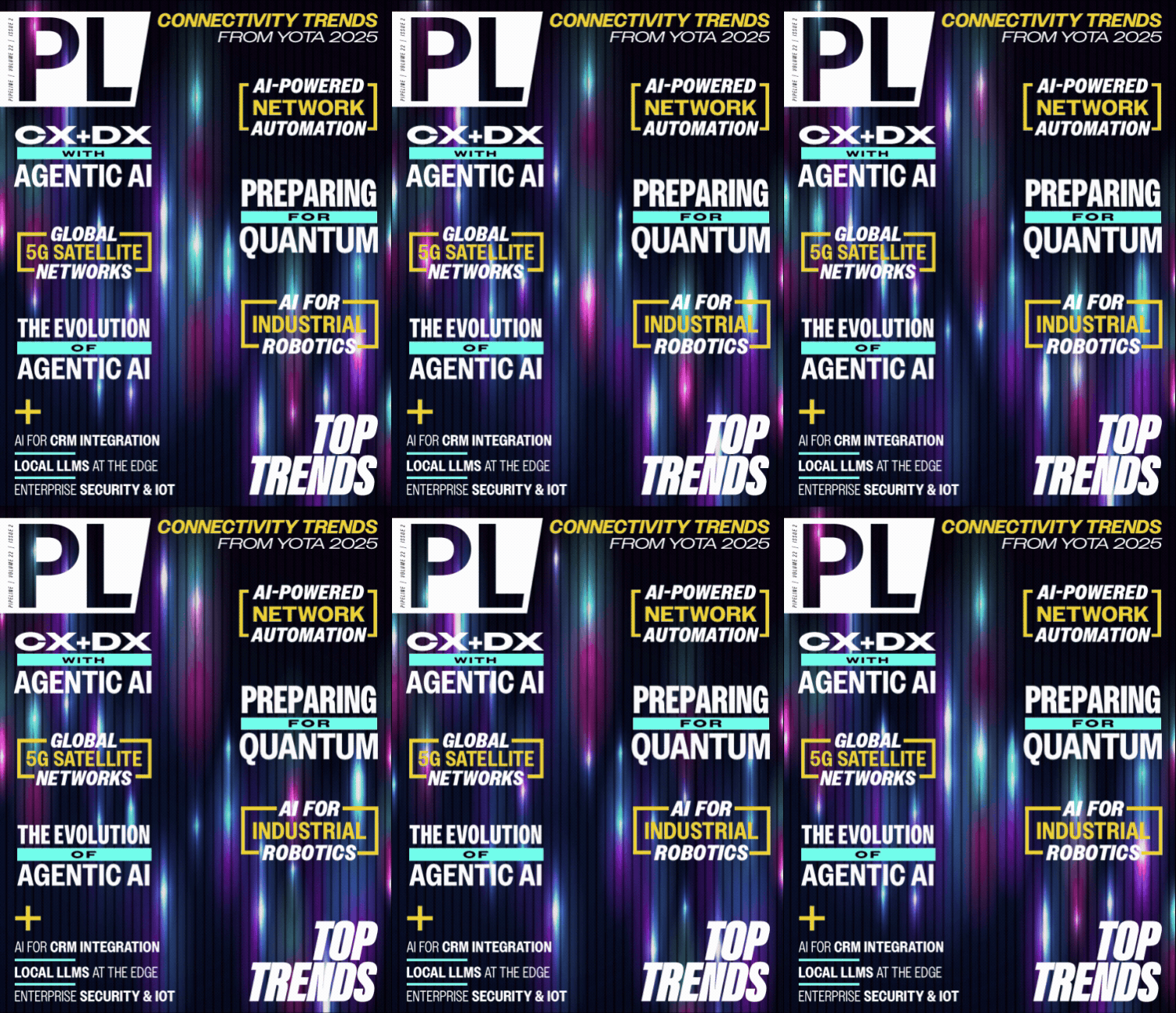
In this issue of Pipeline, Aliro underscores the importance of simulation for quantum network evolution to prepare for Q-day. Cynomi maps the new human-AI partnership that keeps security in human hands. Contributing editor Mark Cummings and Brian Case reveal how trillion-parameter LLMs can now run on modest edge hardware. Nokia proves optical-network automation is now survival-critical for sub-millisecond AI traffic. Alkira demonstrates how to simplify enterprise network management through abstraction, and DE-CIX confirms that latency is the new enterprise currency. ST Engineering iDirect shows how 5G satellite NTN finally delivers true always-on coverage for global IoT and Industry 4.0. Realtime Robotics spotlights robotic manufacturing use cases where robots reprogram themselves in real time. Amdocs argues marketing—not IT—must own the agentic customer interface, and TieTechnology calls for unified AI-CRM strategies to simplify CX across connectivity chaos. All that, plus the latest enterprise and communications news and more.
We hope you enjoy this edition of Pipeline—and that it equips you to deliver the next generation of invisible magic.
Scott St. John
Managing Editor
Pipeline