
Letter from the Editor

In today's hyper-connected world, where every interaction—from streaming a video to managing finances or seeking healthcare—flows through digital channels, customer experience (CX) and digital experience (DX) have become the primary battleground for differentiation. Providers that once competed on price or coverage now stand or fall on how seamlessly, empathetically, and proactively they serve customers across omnichannel journeys. As ubiquitous connectivity deepens with 5G, IoT, and edge computing, the customer journey has evolved into a continuous, predictive, and deeply personalized path. Omnichannel consistency, predictive analytics that anticipate customer needs, and hyper-personalized care aren't luxuries anymore—they're table stakes. When executed well, they build loyalty, trust and drive revenue. When they falter, the damage can be swift and severe.
Consider the infamous 2017 United Airlines incident, where passenger Dr. David Dao was forcibly removed from an overbooked flight, bloodied and dragged down the aisle in full view of smartphone-wielding travelers. The viral video sparked global outrage, boycotts, and a nearly $1 billion drop in market value overnight, underscoring how a single mishandled moment can tarnish a brand for years. More recently, the 2024 murder of UnitedHealthcare CEO Brian Thompson unleashed a torrent of public fury over denied claims, prior authorizations, and perceived indifference—fueled by social media stories of life-altering rejections and a leaked video defending cost controls. The backlash highlighted how poor CX in high-stakes sectors like healthcare erodes trust and invites existential threats to reputation. In healthcare especially, poor CX isn't just a business risk—it can be a matter of life and death. In telecom and finance, similar failed CX patterns emerge: customers rage against long hold times, overseas call centers with language barriers and limited empowerment, forced self-service portals, and a "figure it out yourself” approach lacking humans and empathy. It’s somewhat ironic that customer care representatives, seem to care the least about the customer’s actual experience.
Contrast this with CX exemplars like Charles Schwab, where a live agent answers quickly, is empowered to resolve issues on the spot, and follows up post-interaction to refine the process—creating hyper-personalized, trust-building moments. Yet many providers, including American Express, UnitedHealthcare, Intuit QuickBooks, and far too many telecom operators, default to lowest-cost models: outsourced support with scripted apologies, no real follow-through, siloed systems, and unempowered agents that frustrate rather than fulfill. In telecom, where ARPU stagnates and churn rates typically hover between 15% and 30% annually, failing to respond to evolving needs risks commoditization. Deloitte's 2026 Global Telecommunications Industry Outlook warns that eroding satisfaction—driven by opaque processes and lack of emotional relevance—demands a shift to value-driven ecosystems built on proactive, seamless digital experiences. Bad CX isn't just annoying; it's a multi-trillion-dollar risk, with global consumers ready to reduce or cease spending on brands that disappoint.
Thankfully, technologies like AI—agentic, generative, and predictive—are arriving to bridge these gaps. Good CX not only reduces churn but drives up loyalty and profits—happy customers buy more and place greater trust in what they're getting. Moreover, the customer journey—and thus CX—begins long before someone becomes a customer, in the presales and discovery phases. From AI-driven help desks that mimic human empathy to proactive device management at scale, orchestration platforms unifying employee and customer experiences, and data-driven transformations that close disconnects, the tools exist to move beyond reactive firefighting. CSPs and enterprises can engineer reliability into networks, personalize at the edge, and prove ROI through measurable outcomes like reduced churn and higher loyalty. The question is no longer whether AI can help—it's how thoughtfully we deploy it to restore humanity to digital interactions rather than further automate frustration.
This convergence of rising expectations, proven risks of neglect, and powerful enabling tech makes thoughtful CX/DX strategy more critical than ever. Providers who treat experience as foundational—not an add-on—will differentiate in a saturated market, turning connectivity into genuine value and loyalty. Those who don't risk joining the growing list cautionary tales. In an era where a single viral failure can undo years of brand equity, getting CX right isn't optional—it's survival–and what makes this edition of Pipeline so important.
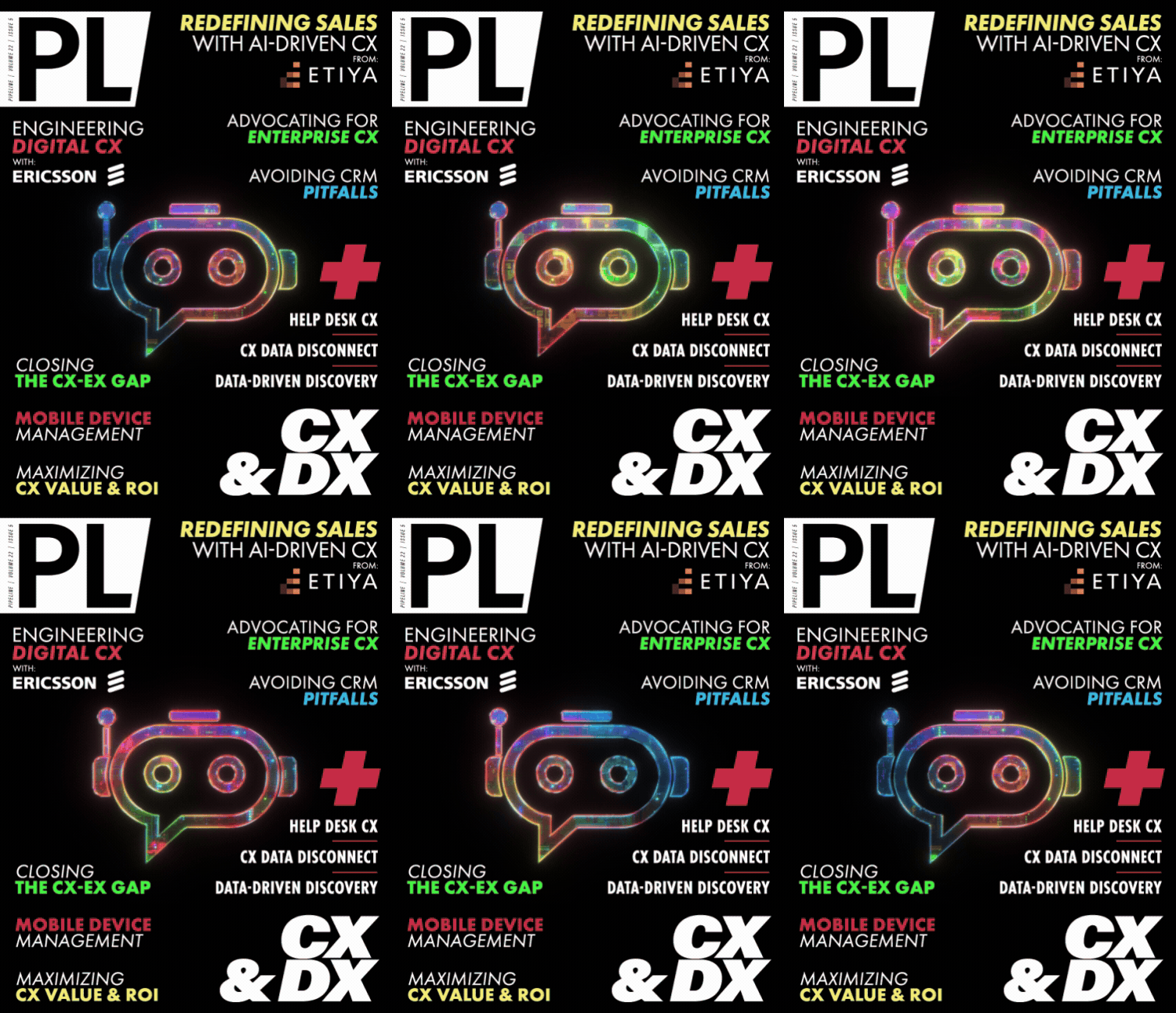
In this issue of Pipeline, we explore the digital customer experience, CX and DX. In a special showcase article, we hear from Etiya on how AI-driven CX can build trust before customers are customers. ServiceNow argues for CRM transformation with unified data and proactive AI to avoid "Customer Relationship Meltdown" from front-to-back disconnects. Ericsson highlights experience-driven network engineering, including digital twins and infrastructure intelligence, to support reliable digital experiences in 5G and beyond. Zappix discusses proving measurable ROI for CX initiatives through integrated planning to justify investments amid budget scrutiny. QPC Group addresses the data disconnect for BPOs, showing how integrated KPIs and real-time visibility enable outcome-based CX in outsourced models. ExSynt emphasizes discovery-driven approaches over data-only transformations to uncover true problems and boost adoption in digital overhauls. VOSS Solutions examines how unifying service management across UC, collaboration, and contact center ecosystems bridges the employee experience gap to deliver reliable CX/DX. Contributing editor Dr. Mark Cummings delves into optimizing Generative AI implementations for help centers to reduce costs while enhancing interactions through better personas and constraints. Motive explores shifting to proactive, personalized mobile device management to meet exploding connectivity demands and prevent disruptions. Zenture Partners critiques legacy telecom procurement models falling behind enterprise AI-driven realities, advocating for unified visibility and advisory approaches. All this, plus the latest enterprise and telecommunications technology industry news and more.
We hope you enjoy this and every issue,
Scott St. John
Managing Editor
Pipeline