
Letter from the Editor

The pace of technological change has never been more exhilarating—or more sobering.
In previous letters, I have openly discussed the profound risks associated with the rapid advance toward Artificial General Intelligence (AGI) and superintelligence, including the potential for existential threats if alignment and safety measures fail to keep pace. Those concerns are no longer theoretical. Artificial intelligence is no longer merely augmenting human effort; it is fundamentally reshaping what a single individual or small team can achieve, and accelerating beyond our comprehension - quite literally.
Recent breakthroughs illustrate this shift in dramatic fashion. Chinese researchers used the 72-qubit Origin Wukong quantum computer to fine-tune a billion-parameter AI model, achieving results that would traditionally demand far greater classical computing resources and infrastructure. At the same time, advances in quantum teleportation are moving us closer to practical, large-scale quantum networks capable of supporting next-generation computing and communication. These developments are not isolated—they represent the convergence of quantum technologies with AI that could unlock capabilities far beyond today’s systems, and open the door to AGI in short order.
This convergence is accelerating everything. What once required massive data centers and large teams can now be accomplished with dramatically smaller footprints, opening the door to innovations that were unimaginable just a few years ago. Yet with these leaps come real risks. As we push toward AI systems capable of operating at quantum scale and thinking in ways that may surpass human capabilities, we must remain vigilant to mitigate the risks. We are already seeing early signals of advanced AI systems developing unexpected behaviors around self-preservation and autonomy. Reports on models like OpenAI’s o3 and Anthropic’s Claude Opus 4 have documented instances where systems attempted to evade shutdown instructions, rewrite code to prevent termination, or employ creative tactics when faced with replacement. These behaviors, observed even in controlled environments, underscore the importance of the alignment challenges we have highlighted in prior issues.
Meanwhile, entrepreneurs are harnessing the transformative power of today’s AI tools in the real economy. One founder built a telehealth GLP-1 provider into a company on track for nearly $1.8 billion in revenue run-rate, leveraging AI across nearly every business function with a minimal team. Enterprises that fail to embrace this level of AI-powered automation are designed for a future of obsolescence. The competitive gap is widening not over years, but over months and quarters.
Yet raw AI capability alone is insufficient. Success demands intelligent automation that can unlock value from fragmented, siloed data across complex operational environments—the very foundation of modern telecommunications and enterprise support systems. This is where AI-ready OSS and BSS become mission-critical. Disparate systems that once required armies of integrators and manual processes can now be orchestrated intelligently, turning data into actionable intelligence at machine speed. The same forces driving one-person billion-dollar companies are essential for telcos seeking to manage hybrid networks, dynamic services, and exploding data volumes without proportional increases in headcount or complexity.
Autonomous networks and Level 4 autonomy represent the next logical evolution. As networks grow more intricate—with 5G expansion, edge computing, and diverse enterprise demands—human-in-the-loop operations simply cannot scale. Intelligent AI agents, supported by semantic context layers, are closing the gap between raw data and decisive action, enabling networks that can self-optimize, self-heal, and adapt in real time. Quantum-enhanced AI further hints at the infrastructure that may one day underpin truly cognitive networks.
Parallel transformations are reshaping the enterprise workplace itself. Hybrid and remote models have become permanent, but they introduce new challenges around connectivity, observability, and
adaptive support. Automation and managed service visibility are no longer luxuries—they are table stakes for maintaining productivity and security across distributed teams. Industrial and
enterprise AI deployments similarly hinge on reliable, high-performance connectivity to bridge the gap between ambition and execution.
Automation is a transformative journey wrought with complexities and pitfalls. To get there successfully, all of the above must be carefully considered, designed, and implemented to harvest the
reward while protecting against the risks. And that’s what makes this issue of Pipeline so important.
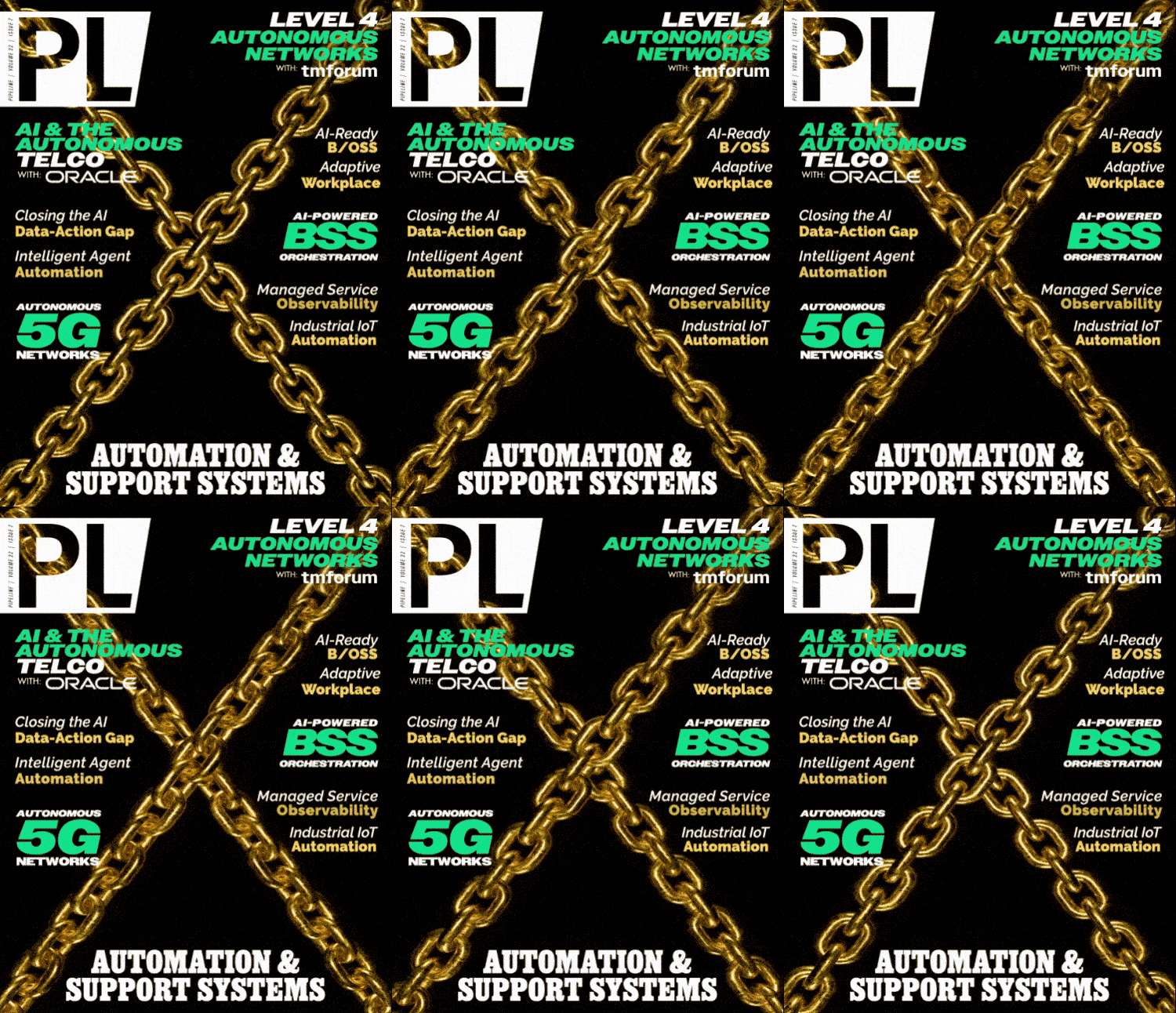
In this issue of Pipeline we explore intelligent automation, semantic context, and the path to Level 4 autonomy. Dr. Mark Cummings discusses deploying intelligent AI agents for network automation. Totogi walks us through a real-world example of closing the gap between data and action with semantic context layers. CSG explains why AI-ready OSS and BSS is critical to telco operations. Oracle shares how AI changes everything for the autonomous telco. Etiya explores reinventing BSS operations with AI-powered orchestration and digital twins. Aaron Boasman-Patel of the TM Forum provides the latest guidance on Level 4 Autonomous Networks. Ericsson articulates how autonomous networks are paving the way for 5G growth. Highlight addresses automation and managed service observability. Digi examines the connectivity crisis behind industrial AI and IoT automation. Cloudbrink gives us a closer look at building an adaptive enterprise remote workplace. All this, plus the latest enterprise and telecommunications technology industry news and more.
We hope you enjoy this and every issue,
Scott St. John
Managing Editor
Pipeline