
Letter from the Editor - August 2026
Agile Network Operations

There are days when the sheer weight of it all feels visceral. Hundreds—sometimes thousands—of systems, APIs, data domains, partner platforms, and network elements that somehow must interoperate seamlessly just to deliver a single service, keep a customer experience intact, and keep the lights on without burning through the budget. For the people responsible for making that work at scale, fragmentation is not an abstract architecture problem. It is the daily tax paid in delayed decisions, brittle resilience, and the constant low-level hum of fear that the next integration failure, token spike, or security incident will expose how loosely everything is still held together and end your career.
The industry’s rush to adopt every flavor of AI has, in many cases, simply recreated the same problem at a higher layer. Agents proliferate. Context stays siloed. Projects get orphaned—pilots that never scale, models that never reach production, technical debt that quietly accumulates while the next initiative is funded. Recent reporting has documented runaway AI costs and enterprises burning through yearly token allocations in months, with agentic loops and retrieval overhead driving total spend even as per-token prices fall. Surveys of IT leaders show the average organization already running a dozen agents, with integration and data fragmentation cited as the dominant barriers to value. Efficient, governed use of these tools is no longer a nice-to-have optimization; it is a financial and operational requirement. Decision latency compounds the problem. When operations, customer experience, and commercial performance still move at human or batch speed, real-time agility remains an aspiration rather than a capability, and far less of a reality.
The connectivity layer isn’t any better. Wireless, fixed, fiber, satellite, and cloud-native cores form a heterogeneous foundation that underpins every modern service, yet the operational complexity of that foundation remains one of the industry’s most stubborn sources of friction. As we noted in our earlier exploration of the innovation stack of the future, connectivity is not optional infrastructure—it is the foundation on which all future innovations are built. The operational implications of taming 5G standalone and cloud-native environments are already here, 6G is arriving sooner than thought, and a deeper look at network evolution will arrive with our October 2026 issue.
Meanwhile, customer experience is still too often assembled from disconnected channels and human bottlenecks. Voice AI is shifting from a deflection tactic to the connective tissue of the service layer—operators and vendors are already embedding real-time speech capabilities deeper into the core—and enterprise cloud voice strategies are becoming the practical enabler of that shift. Connectivity itself is increasingly a commodity. Differentiation now depends on experience and on richer service combinations that inevitably pull in partners. Operational agility that stops at the enterprise boundary simply relocates the friction to outside the firewall.
None of this acceleration or innovation can be pursued without clear-eyed risk management. AI-scale traffic changes the resilience equation. Persistent campaigns against telecommunications infrastructure—from long-running nation-state activity such as Salt Typhoon to more recent espionage operations that continue to surface against carriers—demonstrate how deeply the connectivity layer can be compromised.
Quantum is advancing faster than many roadmaps assumed. Credible estimates for cryptographically relevant capability continue to compress, with some internal readiness targets now sitting in the late 2020s and government migration windows clustering in the early-to-mid 2030s. If you’re keeping track at home, we’re already in the late 2020s – so that’s now. And if you’ve been reading Pipeline, you have had at least three years to prepare. The day classical verification assumptions fail is no longer theoretical.
Pragmatic innovation must therefore price in both financial discipline around AI economics and the hardening required against severe, structural threats. Which is why this edition of Pipeline is so important.
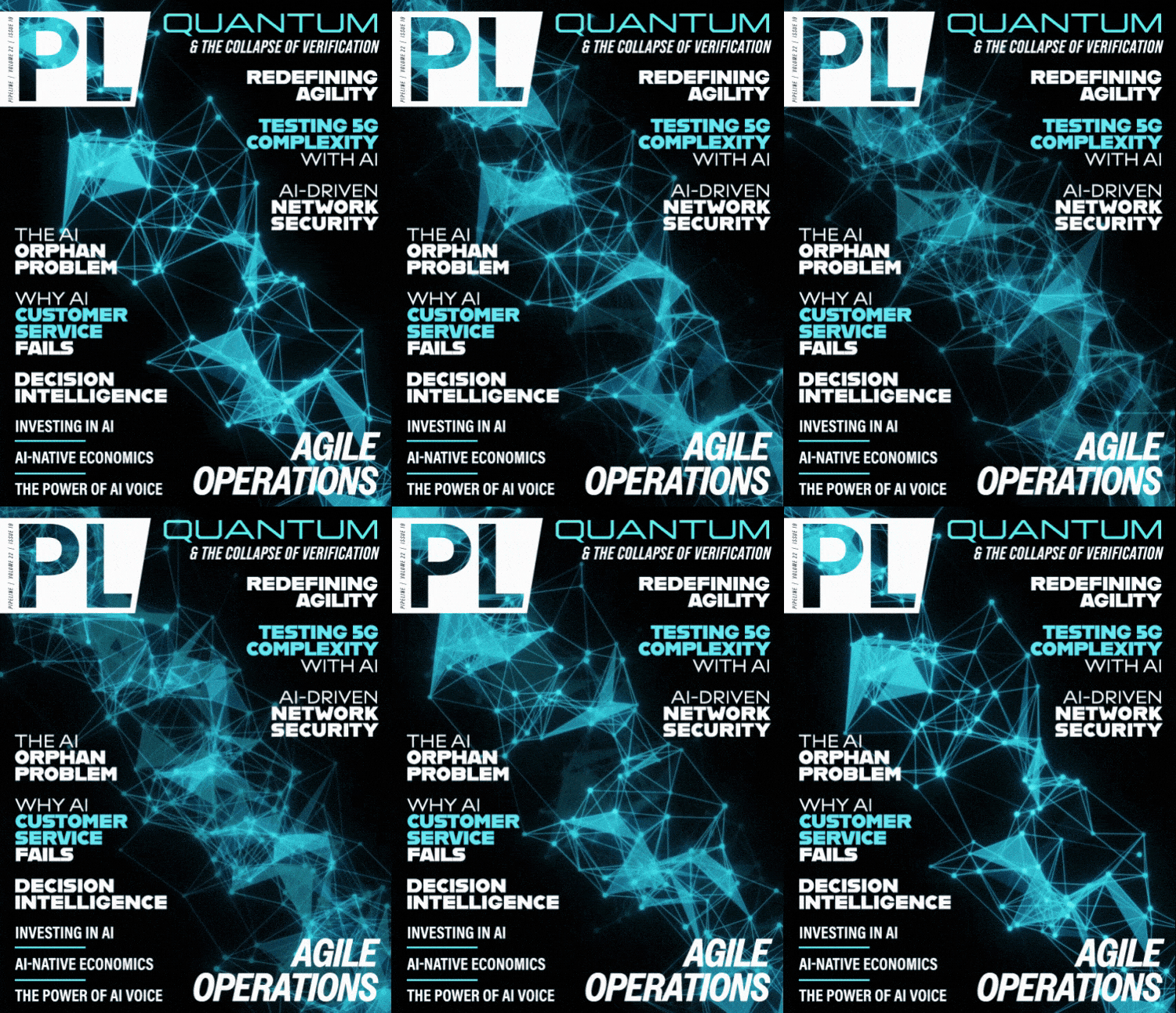
In this issue of Pipeline, we explore agile network operations. F5 examines what it takes for operational resilience as AI-driven traffic becomes part of production infrastructure. Etiya shares how telcos can eliminate decision latency to achieve true real-time agility across operations, customer experience, and commercial performance. ServiceNow foresees voice AI as the connective layer in a modern service experience. Calix looks at operational agility by providing a practical framework to help service providers to overcome AI silos. Apptium explores why operational agility for CSPs must extend beyond internal automation and system modernization to encompass the broader partner ecosystem. Circles challenges us to think beyond operational efficiency gains toward new revenue categories. Spirent discusses the complexity between 5G standalone networks and cloud-native cores. AI researcher Dr. Marty Trevino cautions us about the downside of quantum computing and the eventual collapse of human verification. Dr. Mark Cummings guides us through the efficient use of AI, and Avoxi offers up advice for advancing enterprise cloud voice strategies. All this, plus the latest enterprise and telecommunications technology industry news and more.
We hope you enjoy this and every issue,
Scott St. John
Managing Editor
Pipeline